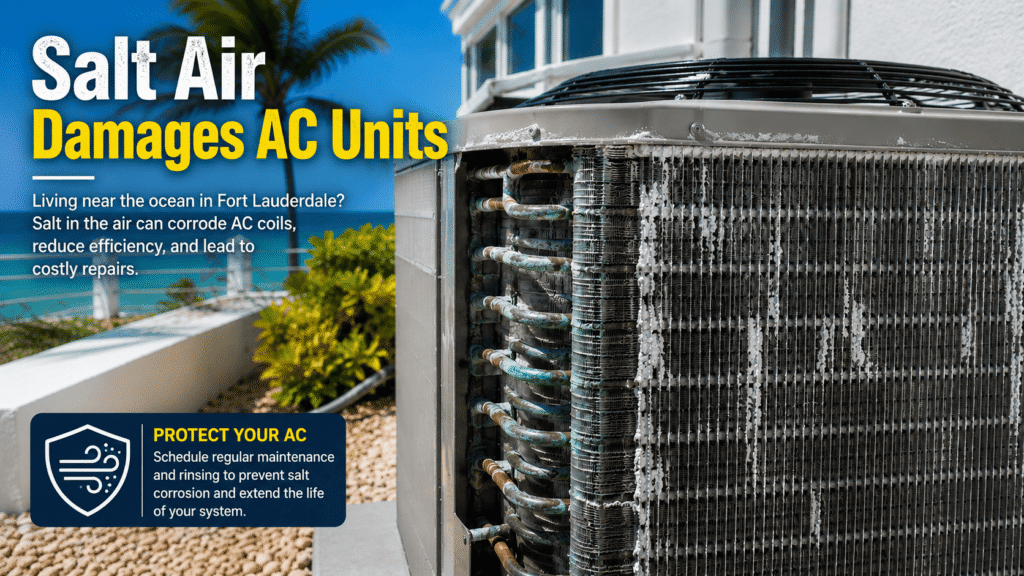
If you own a home or business near Fort Lauderdale’s coastline, salt air AC damage is one of the most serious — and most overlooked — threats to your HVAC system. Every single day, microscopic salt particles carried by coastal winds land on your outdoor AC unit and silently corrode metal components from the inside out. By the time most homeowners notice a problem, the repair bill is already in the thousands.
Why Salt Air Damages AC Units Faster in Fort Lauderdale Than Anywhere Else
Fort Lauderdale sits directly on Florida’s Atlantic coastline — placing it in the path of some of the highest salt air concentrations in the entire United States. Salt air is not simply humid ocean air. It carries suspended sodium chloride particles that travel miles inland, settle on exposed surfaces, and trigger an aggressive electrochemical corrosion process on any metal they contact.
Your AC system’s outdoor condenser unit is packed with metal: copper refrigerant coils, aluminum fins, steel cabinet panels, electrical terminals, and copper refrigerant lines. Every single one of these components is a target when salt air damages AC units in Fort Lauderdale’s coastal environment.
Research shows that HVAC systems within 5 miles of the Florida coastline corrode 2 to 10 times faster than systems located further inland. For homes within 1–2 miles of Fort Lauderdale’s beaches, that rate accelerates even further — meaning a unit that might last 18 years in Orlando could fail in as few as 8 years here without proper protection.
5 Ways Salt Air Damages AC Units in Fort Lauderdale
1. Corroded Condenser Coils
The condenser coil is the heart of your outdoor AC unit. It releases heat from inside your home into the outside air — a process that depends entirely on clean, unobstructed metal surfaces. Salt air damages AC units by pitting copper tubing and dissolving thin aluminum fins, reducing heat transfer efficiency and eventually causing refrigerant leaks that can shut your system down entirely.
Replacing a corroded condenser coil in Fort Lauderdale costs between $900 and $2,500 in parts and labor — a cost that is almost entirely preventable with regular coastal maintenance.
2. Deteriorating Aluminum Fins
The aluminum fins surrounding your condenser coils are razor-thin by design, built to maximize airflow across the heat exchange surface. This thinness makes them extremely vulnerable when salt air damages AC units. Once fins begin to dissolve or break apart, airflow is restricted, your system works harder, energy bills climb, and the compressor faces increased strain leading to premature failure.
3. Rust and Cabinet Deterioration
Your outdoor condenser unit’s steel cabinet uses a factory rust-resistant coating — but years of Fort Lauderdale salt air strip that coating completely. Once rust penetrates the cabinet walls, it spreads inward, damaging internal wiring, contactors, and components. Visible cabinet rust is one of the clearest signs that salt air has been damaging your AC unit for some time.
4. Corroded Electrical Connections
Salt air does not just attack visible metal surfaces — it works its way into electrical terminals, contactors, and wiring connectors hidden inside the unit. Corroded electrical connections cause intermittent failures, prevent the system from starting, drive up energy consumption, and in serious cases create fire hazards. This type of salt air AC damage in Fort Lauderdale is especially dangerous because it is completely invisible until a failure occurs.
5. Refrigerant Line Pinhole Leaks
Copper refrigerant lines running between your indoor and outdoor units are highly vulnerable to coastal corrosion. Salt air creates tiny pinhole leaks that allow refrigerant to escape gradually — reducing cooling capacity so slowly that many Fort Lauderdale homeowners assume their aging unit is just “getting old” rather than being damaged by salt air. A refrigerant leak caused by salt corrosion requires professional repair and recharging, typically costing $200–$600 depending on severity.
7 Warning Signs Salt Air Is Damaging Your Fort Lauderdale AC Unit
Do not wait for a complete system breakdown. Watch for these early warning signs:
- White or greenish deposits on copper lines or coil surfaces — salt and oxidation buildup
- Weak or warm airflow despite the system running constantly
- Rising electric bills with no change in usage or household habits
- Visible rust on the outdoor cabinet, base pan, or mounting bracket
- Hissing or bubbling sounds near refrigerant lines — possible pinhole leak
- System fails to start or shuts off unexpectedly mid-cycle
- AC unit is over 8 years old and located within 2 miles of the Fort Lauderdale coastline
Any one of these signs warrants a professional HVAC inspection immediately. Salt air damage to AC units in Fort Lauderdale compounds quickly — early intervention is always cheaper than full replacement.
5 Proven Ways to Protect Your Fort Lauderdale AC from Salt Air Damage
1. Schedule Twice-Yearly Professional AC Maintenance
For inland Florida homes, annual maintenance is standard. For Fort Lauderdale coastal homes, every 6 months is the minimum recommended service interval. A certified Sfheatandair technician will deep-clean salt deposits from coils, inspect for early corrosion, check and tighten electrical connections, and verify refrigerant levels — stopping salt air damage to your AC before it escalates into a costly repair.
2. Apply a Corrosion-Resistant Coil Coating
A professional coil coating creates a physical barrier between your AC’s metal surfaces and the salt air. Applied by a certified technician, these coatings cost $150–$300 and can extend the life of your coils by 5–8 years. Given that a coil replacement costs up to $2,500, this is one of the best-value investments Fort Lauderdale homeowners can make against salt air AC damage.
3. Rinse the Outdoor Unit with Fresh Water
One of the simplest defenses against how salt air damages AC units in Fort Lauderdale is also one of the most effective: rinse your outdoor condenser unit with a garden hose every 2–4 weeks. Use low pressure, spray top to bottom, and flush all visible salt deposits from fins and coil surfaces. This takes under 5 minutes and costs nothing — but makes a significant difference over time.
4. Choose a Coastal-Rated Replacement Unit
When your current unit reaches end-of-life, invest in an AC system specifically designed for coastal environments. Look for units with factory-applied Blue Fin coatings, galvanized steel cabinets, and weatherproof electrical enclosures. Brands including Carrier, Trane, and Lennox all manufacture coastal-series units built to resist how salt air damages AC units in Fort Lauderdale’s conditions.
5. Install a Protective Screen or Enclosure
A slatted fence or screen placed around your outdoor unit reduces direct exposure to salt-laden winds. Ensure any enclosure maintains at least 2 feet of clearance on all sides to preserve adequate airflow — restricting airflow causes overheating, which is just as damaging as salt corrosion.
How Often Should Fort Lauderdale Homeowners Service Their AC?
For most inland Florida homes, annual AC Unit maintenance is sufficient. In Fort Lauderdale and coastal Broward County, twice-yearly maintenance is strongly recommended — once in spring before peak summer heat and once in fall. Homes within half a mile of the beach should consider quarterly inspections given the extreme salt concentration levels those properties face year-round.
Stop Salt Air from Damaging Your Fort Lauderdale AC Unit
Understanding how salt air damages AC units in Fort Lauderdale is the first step — taking action is what protects your investment. With twice-yearly professional maintenance, a protective coil coating, and regular fresh-water rinsing, Fort Lauderdale homeowners can add years to their AC system’s life and avoid thousands in unnecessary repair and replacement costs.
Frequently Asked Questions (FAQs)
How far from the ocean does salt air start damaging AC units in Fort Lauderdale?
Salt air can damage AC units up to 5 miles from Fort Lauderdale's coastline, depending on prevailing wind direction and speed. Homes within 1–2 miles of the beach experience the most severe and fastest-progressing damage and should prioritize protective coatings and more frequent maintenance.
How much does salt air shorten an AC unit's lifespan in Fort Lauderdale?
A well-maintained AC unit typically lasts 15–20 years in an inland Florida location. In Fort Lauderdale's coastal salt air environment without protection, that lifespan drops to 8–12 years on average. With proper twice-yearly maintenance and coil coatings, you can recover much of that lost lifespan.
Can salt air AC damage be repaired, or does the whole unit need replacing?
It depends entirely on severity. Minor corrosion on fins and coils can be professionally cleaned and coated. Moderate damage may require individual coil replacement. Severe corrosion affecting the compressor, electrical system, or refrigerant circuit typically makes full unit replacement more cost-effective than repeated repairs.
What is the best AC brand for resisting salt air damage in Fort Lauderdale?
Carrier, Trane, and Lennox all offer coastal-rated units built for high-salt environments like Fort Lauderdale. Ask specifically for units with Blue Fin coil coatings and galvanized or stainless steel cabinets — these features provide the strongest long-term protection against salt air AC damage.
Is a coil coating really worth the cost in Fort Lauderdale?
Absolutely. A professional coil coating costs $150–$300 and can extend coil life by 5–8 years. Replacing a corroded condenser coil costs $900–$2,500. For Fort Lauderdale homeowners, a coil coating is one of the highest-return HVAC investments available.
Does rinsing my outdoor AC unit with water actually help against salt air?
Yes — rinsing with a standard garden hose on low pressure every 2–4 weeks is safe, effective, and strongly recommended. It removes accumulated salt deposits before they penetrate and corrode metal surfaces. Never use a pressure washer as it can damage aluminum fins and force water into electrical components.